
Join the channel and become a MEMBER!
https://www.youtube.com/channel/UCQcn…
Join me for some games:
https://www.twitch.tv/jozarov
Send me some of your games for the coaching stream on [email protected]
Support my channel and subscribe.
You can support my channel on https://www.paypal.me/jozarov.
Follow me on:
https://www.facebook.com/jozarov/
https://twitter.com/jozarov
https://www.instagram.com/jozarov/
https://lichess.org/@/jozarov
Thanks for watching. Chess is the best!!
FIDE introduced a 24 game limit, with the title holder Karpov enjoying draw odds. If Karpov lost, he also had the automatic right to a rematch.[6] The prize for the match was 1.6 million Swiss Francs, with 62.5% going to the champion.[7] For each draw, FIDE would deduct 1% of the purse, and fine each player a further 1%.[2] The arbiters were Andrey Petrov Malchev and Vladas Ivanovich Mikenas.[8] Kasparov had vociferously, and successfully, objected to FIDE’s first choice of Svetozar Gligoric and Anton Kinzel, the arbiters from the Karpov – Kasparov World Championship Match (1984), because he thought they had been too ready to follow Campomanes.[9] Karpov’s seconds were Igor Arkadievich Zaitsev, Yuri Balashov,[10] Efim Geller, Sergey Makarichev and Evgeni Vasiukov.[11] Kasparov’s seconds were Aleksander S Nikitin, assisted by Josif D Dorfman, Gennadi Timoshchenko, Evgeny Vladimirov and Alexander Shakarov.[10] The match was played in the Tchaikovsky Hall, Moscow. Evgeny Vladimirov describes the scene: “…amongst the 1,500 spectators and the tens of millions of Soviet chess fans outside, there are no neutrals… Thousands stand in rows six feet deep all around the cordoned off Mayakovsky Square before the start of each game. A ticket for a good seat costs 2½ roubles but on the black market they are changing hands at 15 roubles…”[12]
Kasparov won the 1st game. Karpov evened the score in Game 4 by manoeuvering to build an overwhelming kingside attack, and then went ahead 2-1 when Kasparov pressed too hard for a win in Game 5. Karpov now experienced a period of weak play that lasted throughout the month of October. It started in Game 11, when Karpov made the crude blunder 22…Rcd8. Kasparov won the game with a queen sacrifice, tying the match. Karpov explains that he became distracted when the German news magazine Der Spiegel published a controversial story on September 30. It was about a large sum of money Karpov had allegedly received from a computer sponsorship deal, without notifying the Soviet authorities. This would have constituted a major violation of the exchange control regulations. Karpov was later cleared of the accusations. In an 1988 interview, Karpov agreed with the observation that he never played worse in a match against Kasparov than from October 1 to October 24, 1985. Furthermore, he said that Kasparov would not have become world champion in 1985 without help from Der Spiegel.[13]
In Game 16 Kasparov took the lead with what he regarded to be the “most beautiful” of the match and also “an important turning point. After this game I felt I could win the title, that I must win it. At the same time it became clear that Karpov felt the exact opposite.”[14] Karpov reported that in home analysis before the game, his second Efim Geller had found the improvement 12.Be3, but forgot to tell him![11] After a drawn 17th game Kasparov took a time out, assuming that Karpov would go all out against him with the white pieces in Game 18.[5] Kasparov secured a two point lead when Karpov lashed out unsuccessfully on the kingside in Game 19. The drawn Game 21 ended unexpectedly after Kasparov suddenly noticed a flaw in his adjournment analysis. This seems to have encouraged Karpov, and Kasparov took another time out.[15] Karpov cut the lead to a point by playing aggressively with the white pieces in Game 22. Kasparov explained that he “underestimated the opponent’s pawn offensive on the kingside.”[16] In Game 24 Karpov needed to win in order to tie the match and retain his title. In a “superb fighting game, worthy of a world championship decider,” Karpov built up a promising attacking position, but miscalculated after Kasparov sacrificed two pawns.[17] Garry Kasparov won the game, and so became the 13th world chess champion.
PGN:
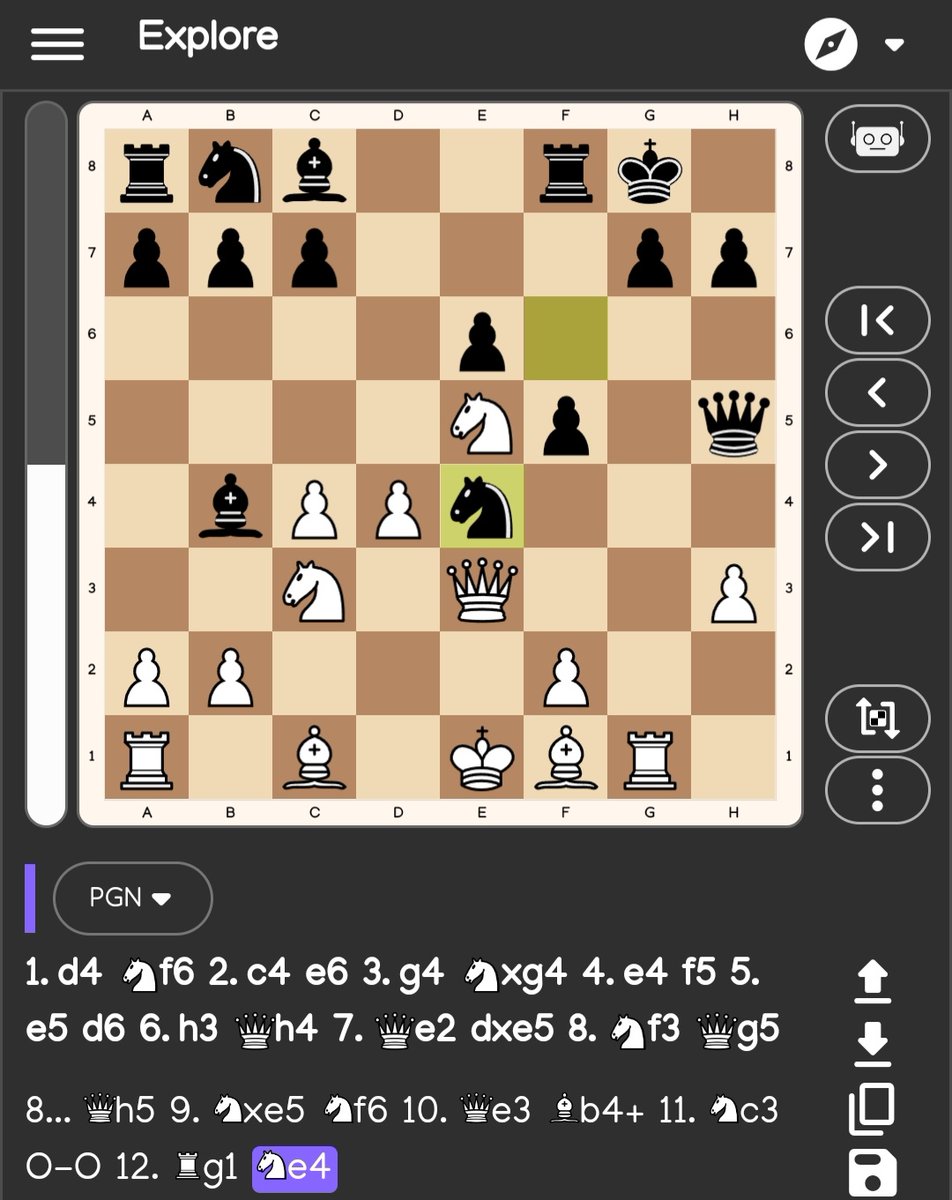
1. d4 Nf6 2. c4 g6 3. Nc3 d5 4. Nf3 Bg7 5. Bf4 O-O 6. e3 c5 7. dxc5 Ne4 8. Qb3 Na6 9. cxd5 Naxc5 10. Qc4 b5 11. Nxb5 Bxb2 12. Bc7 a6 13. Bxd8 axb5 14. Qc2 Bc3+ 15. Qxc3 Nxc3 16. Bxe7 Nb3 17. Rd1 Rxa2 18. Bxf8 Kxf8 19. Nd4 Nxd1 20. Nxb3 Nxf2 21. Rg1 Ng4 22. d6 Nxe3 23. Nc5 Bg4 24. h3 Rc2 25. Na6 Be6 26. Be2 Bc4 27. Bf3 Nf5 28. d7 Ke7 29. Nb8 Rc1+ 30. Kf2 Rxg1 31. Kxg1 Nd4 32. Be4 f5 33. Bb1 Be6 34. Kf2 Bxd7 35. Ke3 Nc6 36. Nxd7 Kxd7 37. g4 fxg4 38. hxg4 Ke6 39. Kf4 Kd5 40. Ba2+ Kd4 41. Kg5 Ne5 42. Bg8 b4 43. Bxh7 b3 44. Bg8 b2 45. Ba2 Kc3 46. Bb1 Kd2 47. Kf4 Kc1 48. Be4 Nc4 49. Bxg6 Na3 50. g5 Nc2


 ;
;